


There is no magic percentage.
A common way to answer this question is to quote a percentage of turnover. That can be a useful sense-check, but it is a poor substitute for a real plan.
Two businesses with the same revenue can rationally spend very different amounts on marketing. One may have repeat customers, high margins and room to grow. The other may be capacity-constrained, low-margin and already turning away work. A percentage does not know the difference.
A better marketing budget starts with six things: revenue, margin, growth target, customer value, competition and sales cycle.
Start with the commercial target.
Suppose you want 20 additional customers per month. Before choosing channels, calculate what one new customer is worth in gross profit, not just revenue. Then decide what you could reasonably spend to acquire that customer while keeping the economics healthy.
For a business with a £100 gross profit per sale, a £150 cost per acquisition clearly fails. For a professional service where one new client is worth several thousand pounds over a year, the acceptable acquisition cost can be much higher.
This is why one-size-fits-all budget advice is dangerous.
Seven questions to answer before setting the budget
1. What is one customer really worth?
Use gross profit and realistic repeat value. Avoid assuming every lead becomes a customer.
2. How quickly do you need results?
SEO and content can create durable value but take time. Paid search can build visibility faster but requires media spend from day one. A company that needs enquiries next month may need a different mix from one planning growth over 18 months.
3. How competitive is your market?
A local service in a small town can face very different click costs and SEO competition from a London professional service.
4. Is the website ready to convert?
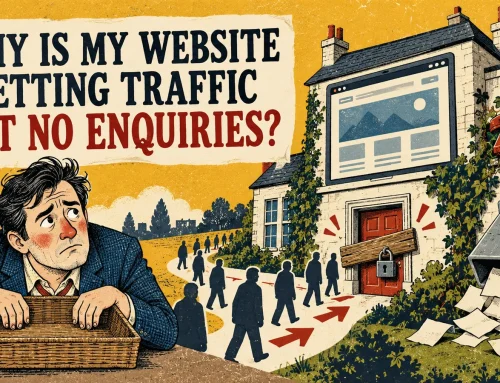
Increasing traffic to a poor website can simply increase waste. Budget may need to go into landing pages, speed, forms, trust signals, pricing clarity and call handling before traffic is scaled.
5. Do you know where enquiries come from?
Without form, call and conversion tracking, a business can spend more without learning more. Treat tracking as infrastructure, not an optional extra.
6. What can the business fulfil?
There is little value in generating 100 extra leads if the team can only handle ten.
7. How much testing can you afford?
New campaigns need enough volume to learn. A budget that produces three paid clicks a week may be too small to tell you anything useful in a competitive market.
Example 1: small local service business
Imagine a local trades or service business with a good reputation and limited geographic radius. A sensible starting budget might be £700-£1,500 per month in total marketing investment, depending on competition.
That could be divided between local SEO/Google Business Profile work, a modest Google Ads budget, website improvements and simple content. If demand is already strong from referrals, the business may need less. If it is entering a crowded market with no existing visibility, it may need more.
The important thing is to avoid buying five weak channels. One well-managed paid campaign plus a strong local website can be more useful than tiny budgets scattered across Google, Meta, SEO, email and social media.
Example 2: growing professional service company
A consultancy, clinic, accountancy firm, legal practice or other professional service may have higher customer value and a longer decision process. A working budget might be £1,500-£4,000+ per month, potentially plus larger ad spend.
The mix may include Google Ads, service-page improvements, SEO content, case studies, call tracking and conversion optimisation. Because one new client can be valuable, the economics may support a higher cost per lead than a low-ticket consumer business.
Example 3: e-commerce business
E-commerce needs a different calculation because margin, repeat purchase rate, returns and fulfilment matter. A business might allocate a larger proportion to paid media, creative and email retention while continuing to invest in SEO and conversion rate optimisation.
The key number is not traffic; it is contribution after product cost, advertising, fees, discounts, returns and fulfilment. Scaling a campaign that loses money on each order simply creates a larger loss.
Example 4: competitive London business
A London clinic, financial service, property company or high-value B2B firm can face stronger search competition. A budget below £2,000 per month can still work in the right niche. Still, many competitive businesses will need a larger total investment once paid media, SEO/content and website work are combined.
That does not mean “London = expensive” by default. It means the business should look at actual CPCs, competitors and ranking difficulty before choosing a figure.
How to split a monthly marketing budget
There is no fixed split, but here is a practical example for a £3,000 monthly budget:
£1,200 paid advertising media spend
£600 paid advertising management and optimisation
£700 SEO/content and internal linking
£300 website/landing-page improvements
£200 tracking, reporting or creative support
Another business may put nearly all of the budget into SEO for six months. A third may invest heavily in a website first, then scale traffic later. The correct split depends on the bottleneck.
Advertising spend and agency fees are not the same
This distinction causes surprising confusion.
If you pay £1,000 to Google, that money buys ad exposure and clicks. If an agency charges £300 to manage the campaign, the total paid-search cost is £1,300. Some agencies bundle these; others invoice them separately. Either approach can work, but you should always be able to see the numbers clearly.
Google explains that most campaigns operate from an average daily budget and a monthly spending limit. That tells you what can be spent. It does not tell you what should be spent. Your budget needs to be linked to CPC, expected conversion rate and customer value.
When a £399 social media package can make sense
Spiders & Milk’s £399 + VAT social media management offer suits a business that wants consistent, professional social activity without hiring someone in-house and without needing an intensive video, influencer, or paid-social programme.
It is most appropriate when social media is a supporting channel: keeping the business visible, building prospect confidence, sharing useful content, and maintaining consistency.
It is not a substitute for a larger growth programme where the real issue is poor Google visibility, weak landing pages or a need for high-volume lead generation. In those situations, social media may be one component rather than the main investment.
When to spend more
Increase the budget when the current activity is demonstrably profitable, the business can handle more demand, the market has additional reachable volume, and tracking is reliable enough to show what is working.
Do not increase it just because an advertising platform recommends a higher budget. A recommendation can identify lost traffic, but your business economics still come first.
When to spend less – or pause
Reduce or redirect spend when tracking is broken, the website is failing, enquiries are not being answered, the offer is uncompetitive, or the business cannot fulfil more work.
Marketing does not operate in isolation. A campaign can generate excellent leads and still appear unsuccessful if the phone isn’t answered or quotes aren’t followed up.
A simple budget formula
A useful planning formula is:
Target customers x acceptable acquisition cost = maximum acquisition budget
Then add the cost of the marketing infrastructure required to create and measure those opportunities: agency time, content, website work, tracking and creative.
Work backwards from the commercial outcome instead of forwards from an arbitrary percentage.
Build a budget you can sustain
The best budget is not the largest number you can tolerate for one month. It is a level you can sustain long enough to gather evidence, make improvements and judge the result fairly.
A three-week SEO trial tells you little. A paid campaign with no conversion tracking tells you even less.
Request a marketing review
If you are unsure where your next £1,000, £3,000 or £5,000 of marketing budget should go, request a marketing review from Spiders & Milk. We will look at the bottleneck first, then recommend where the budget is most likely to be useful.
Frequently asked questions
What percentage of revenue should a small business spend on marketing?
Percentages can be a useful sense-check but should not dictate the budget. Customer value, margin, growth target, competition, and sales capacity matter more.
How much should a small business spend on Google Ads?
Enough to generate meaningful click and conversion data in its market. The right figure depends on CPC, geography, conversion rate and customer value rather than a universal minimum.
Should marketing agency fees come out of the same budget as ad spend?
Consider them together when calculating total marketing investment, but show them separately so you can see what goes to the media platform and what goes to management.
Is £399 a month enough for marketing?
It can be enough for a focused service such as Spiders & Milk’s social media management offer. It would not normally fund a full multi-channel growth programme.




Leave A Comment