

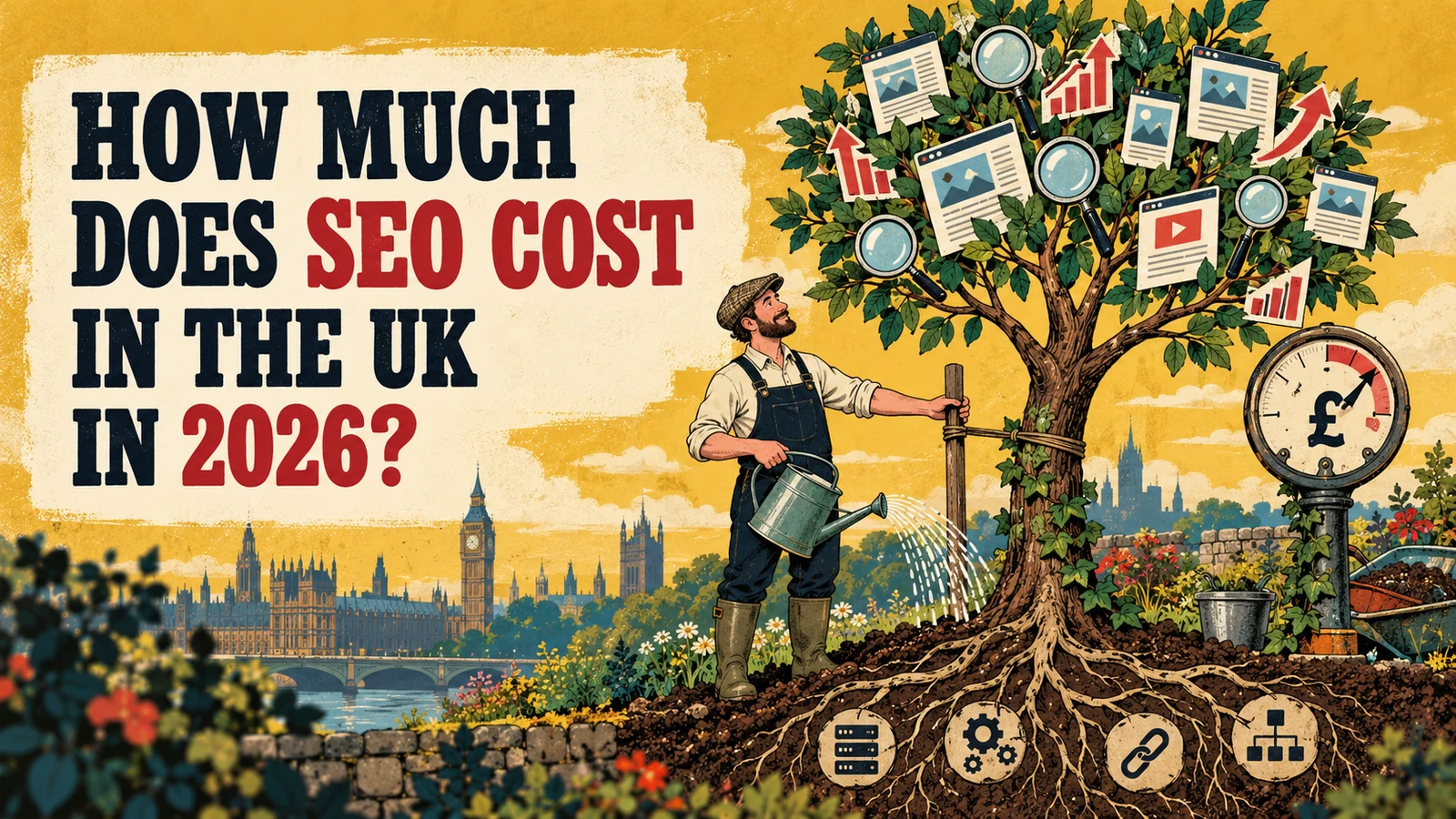
SEO is not one product
Asking “How much does SEO cost?” is like asking how much a website costs. The answer changes with the size of the site, the strength of the competition, the website’s technical condition, the amount of content required, and the commercial ambition.
A local business that needs its Google Business Profile, core service pages and technical basics improved has a very different job from a national company trying to outrank established brands across dozens of topics.
For that reason, this guide uses planning bands, not invented industry averages.
A useful way to think about UK SEO budgets
Under roughly £500 per month
This can fund useful work when the scope is genuinely small: local SEO maintenance, light technical support, a small amount of content or consultancy. It is unlikely to support a deep national SEO programme with frequent expert content and significant technical work.
Be especially cautious if an ultra-cheap package promises hundreds of links, dozens of articles and first-page rankings. The arithmetic rarely supports quality work.
Roughly £500-£1,500 per month
This can support a structured programme for many smaller businesses, particularly where the site is not huge. The exact mix may include technical fixes, keyword/entity research, local optimisation, service-page improvements, internal linking and a regular content schedule.
At the lower end, priorities matter. A sensible agency may deliberately focus on the pages closest to revenue rather than trying to “SEO the whole website” at once.
Roughly £1,500-£3,500+ per month
This is more realistic for businesses in competitive markets that need substantial content production, technical work, multiple service or location pages, ongoing analysis and broader topical coverage.
A well-structured topical-authority programme can sit in this range or higher because it requires research, architecture, content production, internal linking and repeated refinement rather than occasional blog posting.
Larger programmes
Large e-commerce sites, national brands and highly competitive sectors can require substantially more. At that point the budget is buying a team and an ongoing production system, not just a monthly “SEO package”.
What should actually be included in SEO?
Technical SEO
This includes crawlability, indexing, canonicalisation, redirects, duplicate content, internal architecture, mobile issues, site speed, structured data where appropriate and technical errors that prevent search engines or users from accessing content properly.
Google’s Search Essentials say that sites should focus on helpful, reliable, people-first content and make it easy for search engines to understand pages. Technical foundations support that; they do not replace useful content.
Keyword and entity research
Modern SEO should understand both the phrases people type and the broader topics, services, locations and entities the website needs to explain clearly.
Research should map real search intent to the correct page rather than forcing the same keyword into every article.
Content
Content can include service pages, location pages, guides, FAQs, comparisons, case studies and supporting articles. The goal is not to hit an arbitrary word count. It is to answer the questions a genuine buyer has and demonstrate that the site understands the subject.
Internal linking
Internal links help users move through related information and help search engines understand relationships between pages. They are one of the most underused parts of many SEO programmes.
Local SEO and Google Business Profile
Local businesses may need location relevance, review strategy, service information, profile optimisation and consistent business information across the web.
Reporting and ongoing optimisation
Useful reporting should show organic clicks, landing-page performance, conversions, ranking movement where useful, completed work and the next priorities. A ranking report by itself is not an SEO strategy.
Basic monthly SEO versus topical authority
Basic SEO often works page by page: fix technical issues, improve priority pages, add content and monitor performance.
A topical-authority programme goes further. It maps a subject in depth, identifies the questions and subtopics a strong site should cover, designs the relationship between those pages and builds internal links. As a result, the site becomes a coherent resource rather than a pile of disconnected blog posts.
That approach requires more planning and content production, so it should not be priced like a small local maintenance package.
Why London SEO can cost more
London is not automatically a surcharge. London campaigns can require larger budgets because of competition.
Government business-population data shows London has more private-sector businesses than any other UK region. In some professional and healthcare markets, search results are crowded with established companies investing heavily in websites, content and advertising.
If competitors have years of strong content and authority, closing the gap takes more work. The agency should demonstrate that competitive gap rather than simply say “London costs more”.
How long should SEO take?
There is no honest universal answer. Technical fixes can improve crawling quickly. A weak page can sometimes respond relatively fast. Building authority across a competitive topic can take months.
Google states that no secrets automatically rank a site first, and it warns businesses that nobody can guarantee a number-one position. That is why credible SEO proposals focus on work, evidence, and direction rather than promises.
Warning sign 1: guaranteed rankings
If an agency guarantees position one, Google advises businesses to look elsewhere. Competitors and Google’s systems affect rankings; no outside agency controls the results page.
Warning sign 2: vague deliverables
“Monthly optimisation” is not enough detail. Ask what will actually be changed or produced: pages, technical fixes, content briefs, articles, internal links, local work, reporting and testing.
Warning sign 3: hundreds of cheap links
Link building can still matter, but volume is not quality. Buying large quantities of low-quality links creates risk rather than durable authority.
Warning sign 4: content with no strategy
Publishing generic articles because a package includes “four blogs a month” can waste money. Each piece should have a reason to exist, a target intent and a place in the site structure.
Warning sign 5: measuring only rankings
Rankings can move while enquiries stay flat. Organic performance should connect to landing pages, calls, forms and commercial outcomes where tracking allows.
How to compare two SEO quotes
Ask each agency to explain:
which pages are the priority and why
the main technical problems
the content gaps
the competitive gap
what will be delivered in the first three months
what they expect to learn before changing the plan
how conversions will be measured
who creates and approves content
what happens if the website needs development work
The cheaper proposal can be better if it is focused. The expensive proposal can be better if it includes substantially more expert work. Price only makes sense beside scope.
Should SEO be your first marketing investment?
Not always.
If the website is broken, tracking is missing, or the business needs enquiries immediately, paid search or website work may deserve priority.
SEO is strongest when the company can invest consistently and values the long-term asset created by better pages, better visibility and deeper topical coverage.
For examples of the services involved, see our London City Healthcare project and Clearcut Physiotherapy project, alongside our UK SEO services.
Request a marketing review
If you are comparing SEO quotes or wondering whether your current SEO activity is doing enough, request a marketing review from Spiders & Milk. We can assess the website, the competitive gap and whether basic SEO or a deeper topical-authority programme is the more sensible fit.
Frequently asked questions
How much does SEO cost per month in the UK?
No single average fits every business.
Small local programmes can begin with a few hundred pounds, while competitive or content-heavy programmes can require several thousand pounds a month.
How long does SEO take?
Some technical or page-level improvements can show sooner, but competitive SEO usually needs sustained work over months.
No agency can honestly guarantee a fixed ranking date.
What is topical authority SEO?
It is a structured approach to covering a subject comprehensively through connected pages, strong internal linking, useful content and clear topical relationships rather than publishing isolated blogs.
Can an SEO agency guarantee first place on Google?
No. Google explicitly warns that nobody can guarantee a number-one ranking.



Leave A Comment