

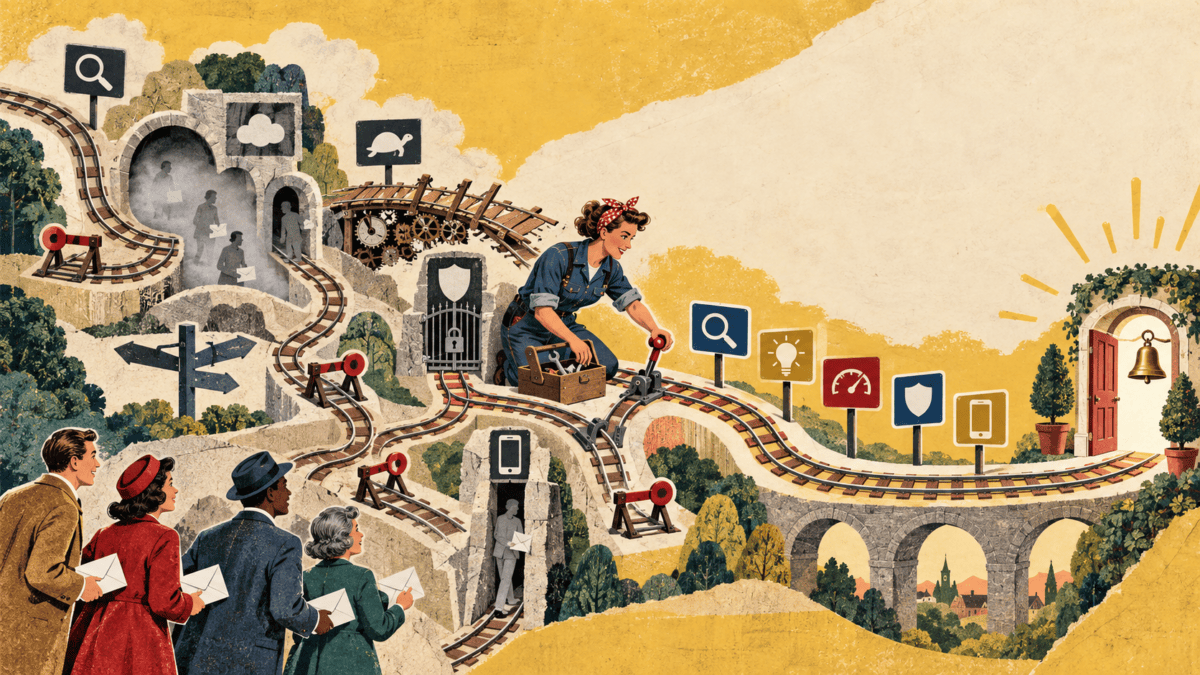
If your website is not generating enquiries, the first question is not whether you need a new website. It is whether the problem is traffic or conversion.
If hardly anyone is visiting the site, you have a visibility problem. SEO, Google Ads, local search or other marketing channels may need attention.
If plenty of relevant visitors are arriving but very few are contacting you, the website itself may be the bottleneck.
Understanding which problem you have prevents you from spending money fixing the wrong thing.
What Does Lead Generation Mean for a Website?
A website lead is a visitor who takes a meaningful step towards becoming a customer. Depending on the business, that might include:
- Completing an enquiry form
- Calling the business
- Requesting a quotation
- Booking a consultation
- Registering for an event
- Downloading a useful resource
- Starting a live chat or sending a message
A website therefore has two jobs. It must attract relevant people and help them move confidently toward an appropriate action.
Traffic matters, but it is only the beginning. Ten well-matched visitors who understand your offer and trust your business may be more valuable than 1,000 poorly targeted visitors.
1. Your Website Is Attracting the Wrong Visitors
Before changing the design, check whether the people arriving on the website are potential customers.
A page can generate considerable search traffic for an informational phrase without attracting people who are ready, or commercially suitable, to enquire. Paid advertising can create the same problem when keywords, locations, audiences or advertising messages are too broad.
Review the search terms, landing pages and locations producing your traffic. Ask:
- Do these searches relate directly to a service we provide?
- Are visitors located within the area we serve?
- Does the page match the likely intention behind the search?
- Are we attracting potential customers, researchers, jobseekers or existing clients looking for support?
Do not judge marketing by visitor numbers alone. Qualified traffic, enquiries and revenue are more useful measures of success.
How to fix it
Align every important page with a defined audience, search intention and commercial purpose. Organic pages should target subjects closely connected to your expertise and services. Paid campaigns should use carefully controlled targeting, meaningful exclusions and dedicated landing pages where appropriate.
2. Visitors Cannot Quickly Understand What You Offer
People should not have to investigate your website to discover what your business does.
The opening section of an important page should make the offer clear. It should tell the visitor what is available, who it is for and why they should consider your business. Clever headlines can be memorable, but vague language often hides the information a prospective customer needs.
Phrases such as “unlocking possibilities” or “solutions for tomorrow” may sound impressive while communicating almost nothing.
How to fix it
Use a clear main heading supported by a short explanation of the service and its value. Replace broad claims with specific, useful information. Where relevant, mention the audience, location, problem solved or outcome supported.
Your main heading should also accurately describe the page. Google recommends using the words people would use to find your content in prominent places such as the page title and main heading—but clarity for the reader must come first.
3. Your Website Talks About the Business, Not the Customer
Many websites open with a company history, internal process or long list of credentials. Those details can support trust, but they rarely answer the visitor’s immediate questions:
- Can you solve my problem?
- Is this suitable for me?
- What will happen next?
- Why should I choose you?
- How much time, money or effort might this require?
A strong page connects the business’s expertise with the customer’s situation. It acknowledges the problem, explains the available solution and removes uncertainty from the next step.
How to fix it
Review the page from the customer’s perspective. Lead with their need, then explain how your service addresses it. Use “you” naturally. Describe practical benefits without making exaggerated promises, and include the information a serious buyer would need before making contact.
4. There Is No Clear Call to Action
Some websites describe a service thoroughly but never clearly ask the visitor to do anything. Others offer so many competing actions that the visitor cannot decide which one matters.
A call to action should give the page a logical next step. “Contact us” may be suitable, but a more specific instruction can be stronger: “Request a quotation”, “Book an introductory call” or “Discuss your project”.
How to fix it
Choose one primary action for each important page. Make it visually noticeable and repeat it at sensible points, particularly after sections that answer common objections. Secondary actions can be included where they genuinely help, but they should not compete equally with the main goal.
On mobile devices, make telephone numbers tappable and buttons large enough to use comfortably.
5. The Page Has Not Earned Enough Trust
Making an enquiry involves risk. The visitor may be sharing personal details, committing time or considering a significant purchase. If the website feels anonymous, outdated or unsupported, they may leave even when the service appears relevant.
Trust is built through evidence and transparency. Useful signals may include:
- Genuine reviews or testimonials
- Relevant qualifications, accreditations or memberships
- Named team members with credible biographies
- Detailed case studies
- Clear contact and location information
- Transparent processes, fees or starting prices where appropriate
- Privacy information and secure browsing
- Consistent branding and professional presentation
How to fix it
Place the most relevant evidence near the decision it supports. A testimonial about a particular service is often more persuasive on that service page than in a separate testimonials archive. A recognisable person, a clear process and specific proof usually create more confidence than unsupported claims such as “industry-leading”.
6. Your Forms Create Too Much Friction
Every unnecessary field gives a visitor another reason to stop. A first enquiry rarely needs a complete customer record.
Long forms can feel intrusive, particularly when the website has not explained why the information is required. Technical errors, unclear validation messages and forms that are awkward to complete on a phone can quietly destroy conversions.
How to fix it
Request only the information needed to respond effectively. Use clear labels, test validation messages, and explain what will happen after submission. Confirm that the form works on different devices and that notifications reach the right person.
Do not stop at the form itself. A prompt, helpful response is part of the conversion journey. An enquiry that sits unanswered for several days is not a successful lead-generation process.
7. The Website Is Slow or Difficult to Use on Mobile
A page may look excellent on a large office screen but perform poorly on a phone on a mobile connection.
Large images, excessive scripts, unstable layouts and intrusive pop-ups can make a website frustrating to use. Google’s Core Web Vitals assess loading performance, responsiveness and visual stability. They are not a shortcut to rankings, but they reflect real aspects of user experience.
How to fix it
Compress and correctly size images, remove unnecessary scripts and plugins, improve caching and hosting where required, and prioritise the content needed at the top of the page. Test navigation, forms, buttons and page layouts on actual mobile devices rather than relying solely on a desktop preview.
Technical scores should guide investigation, not replace human judgement. The real question is whether a potential customer can understand and use the page without delay or frustration.
8. Your Landing Page Does Not Match the Marketing Message
If an advert promotes a particular service but sends visitors to a general homepage, the customer must find the relevant information for themselves. The same mismatch can occur when a search result promises a detailed answer but the page offers only a thin sales pitch.
This breaks continuity. The visitor clicked because of a specific need, and the landing page should immediately confirm that they are in the right place.
How to fix it
Ensure the heading, opening copy, imagery and offer reflect the source that brought the visitor to the page. For important campaigns, create focused landing pages that answer the relevant questions and lead towards one suitable action.
9. Important Questions Remain Unanswered
Visitors often leave because they cannot find a vital piece of information. It might be price, availability, location, suitability, timescale, delivery, cancellation terms or what happens after they enquire.
Hiding every detail in the hope that people will make contact can have the opposite effect. Customers increasingly want enough information to decide whether an enquiry is worthwhile.
How to fix it
Use sales conversations, emails, search data and feedback from your team to identify recurring questions. Answer them within service pages and supporting articles. This creates a more useful customer journey and helps build the depth of subject coverage that supports organic visibility.
10. You Are Not Measuring Real Conversions
You cannot improve lead generation reliably if you do not know which pages and channels produce enquiries.
Basic analytics may show page views and traffic sources, but businesses should also measure meaningful actions such as completed forms, telephone calls, bookings and quotation requests. Google Ads specifically recommends conversion tracking so advertisers can assess metrics including conversions, cost per conversion and conversion rate.
How to fix it
Create a clear measurement plan. Record each meaningful lead action and test the tracking. Where possible, connect leads with their source and assess quality—not simply quantity.
Be careful with thank-you-page tracking alone. If the page can be visited without submitting the form, results may be inflated. Likewise, a click on a telephone number shows intent but does not necessarily confirm that a call connected. Use the most reliable measurement available and understand its limitations.
A Practical Order for Fixing a Website That Does Not Generate Leads
Avoid changing everything at once. Start with the biggest breaks in the journey:
- Confirm that tracking works.
- Identify which channels, searches and pages attract relevant visitors.
- Review the offer and opening message on key landing pages.
- Choose one primary call to action for each page.
- Add evidence that answers the visitor’s trust concerns.
- Simplify forms and test every contact route.
- Improve mobile usability and page performance.
- Measure changes over a meaningful period.
This order prevents a common mistake: redesigning a website before understanding the actual problem.
More Traffic or Better Conversion: Which Do You Need?
If the website receives very little relevant traffic, improving conversion alone will have limited impact. If plenty of suitable visitors arrive but nobody enquires, increasing advertising spend is likely to waste money.
Most businesses need a considered combination of acquisition and conversion work. SEO, Google Ads, social media and email can bring people to the website. Clear messaging, proof, usability and a well-designed next step turn more of those visits into opportunities.
The website should therefore be treated as part of the marketing system—not as a brochure that sits separately from it.
Frequently Asked Questions
What is a good website conversion rate?
There is no universal figure. Conversion rates vary by industry, service, traffic source, device, location, price and the commitment required. Compare like with like, monitor lead quality and use your own reliable baseline to judge improvement.
Why am I getting website traffic but no enquiries?
Common causes include poorly targeted traffic, unclear messaging, weak trust signals, difficult forms, slow mobile performance, an unsuitable offer or missing conversion tracking. Review the complete journey rather than assuming traffic volume is the problem.
Should every website page have a call to action?
Every commercially important page should provide a logical next step. That action does not always need to be a sales enquiry; an early-stage article might lead to a related guide or service page. The action should match the visitor’s likely stage of decision-making.
Will a new website automatically generate more leads?
Not necessarily. A new design can improve usability and credibility, but it will not fix unsuitable traffic, a weak offer or poor follow-up on its own. Diagnose the underlying problems before deciding whether targeted improvements or a full rebuild is appropriate.
Turn Your Website Into a More Effective Source of Enquiries
A website that is not generating leads does not always need to be replaced. Often, the greatest improvements come from understanding the audience, clarifying the offer, strengthening trust and removing friction from the route to enquiry.
At Spiders & Milk Digital, we examine websites as part of the wider marketing journey. That means looking beyond appearance to consider search visibility, advertising, content, user experience, conversion tracking and what happens after someone gets in touch.
If your website receives visitors but fails to produce enough meaningful enquiries, contact us to discuss where the journey may be breaking down and what to fix first.



Leave A Comment